Showing posts with label wage equality. Show all posts

Tuesday, December 3, 2013

Repost: Women finding new job opportunities in field of construction

Another article that agrees that tradeswomen are the answer to the projected labor shortages in construction.
-------------------------------------------------------------------------------------

(CBS News) BURLINGTON, Vt. -- Just three percent of women work in construction, but now there's an unprecedented opportunity to get more of them into the trades. The average construction worker is in his 40s and 50s and getting closer to retirement.
Amy Judd / CBS News

"Seventy-five percent of owners say they face labor shortages," says Tiffany Bluemle, who runs Vermont Works for Women, which trains girls and women in nontraditional trades. "So why would you not deliberately recruit 50 percent of the population for the jobs that you have?"

Amy Judd, a college graduate, picked up a hammer 15 years ago when she could not find a job teaching.

"It had never occurred to me that I would want to be a carpenter," Judd says. "It took me 80 swings to finally actually hit the nail, but when I did, that was my light bulb moment."

The economy is expected to add nearly 200,000 carpenters by 2020.

"I don’t think it's made clear for women in high school to say, 'Hey, this is an option for you,'" says Sylas Demello, an electrician apprentice. "You can go into the trades. You don't have to go to college. You can be an electrician, you can be a carpenter, you can be a mason. You can do all this kind of stuff."

Last year, the Labor Department allocated close to $2 million in grants for women in "nontraditional" occupations like construction.

"It's not always necessarily wearing a tool belt, carrying heavy things," Judd says. "If you like just being creative, or designing things, or problem solving, you can make a really good livable wage."

The average wage for someone working in construction is $26 an hour. Amy Judd now has her own business. Half of her eight employees are women.

© 2013 CBS Interactive Inc. All Rights Reserved.

View the original article at http://www.cbsnews.com/.

Tuesday, September 10, 2013

Repost: Female pipefitter in training gives thanks for Trade-Up’s pre-apprenticeship program


As the United States pauses to honor workers on Labor Day, one Atlanta mother is thankful and proud that she’s on her way to becoming a pipefitter.
Jacquelyn Treadville-Samuels is changing careers after working as a forensic science technician in Atlanta and Alabama. She lost her taste for that work after caring for her cancer-stricken mother in Alabama. She returned to Atlanta and became homeless while looking for a job.
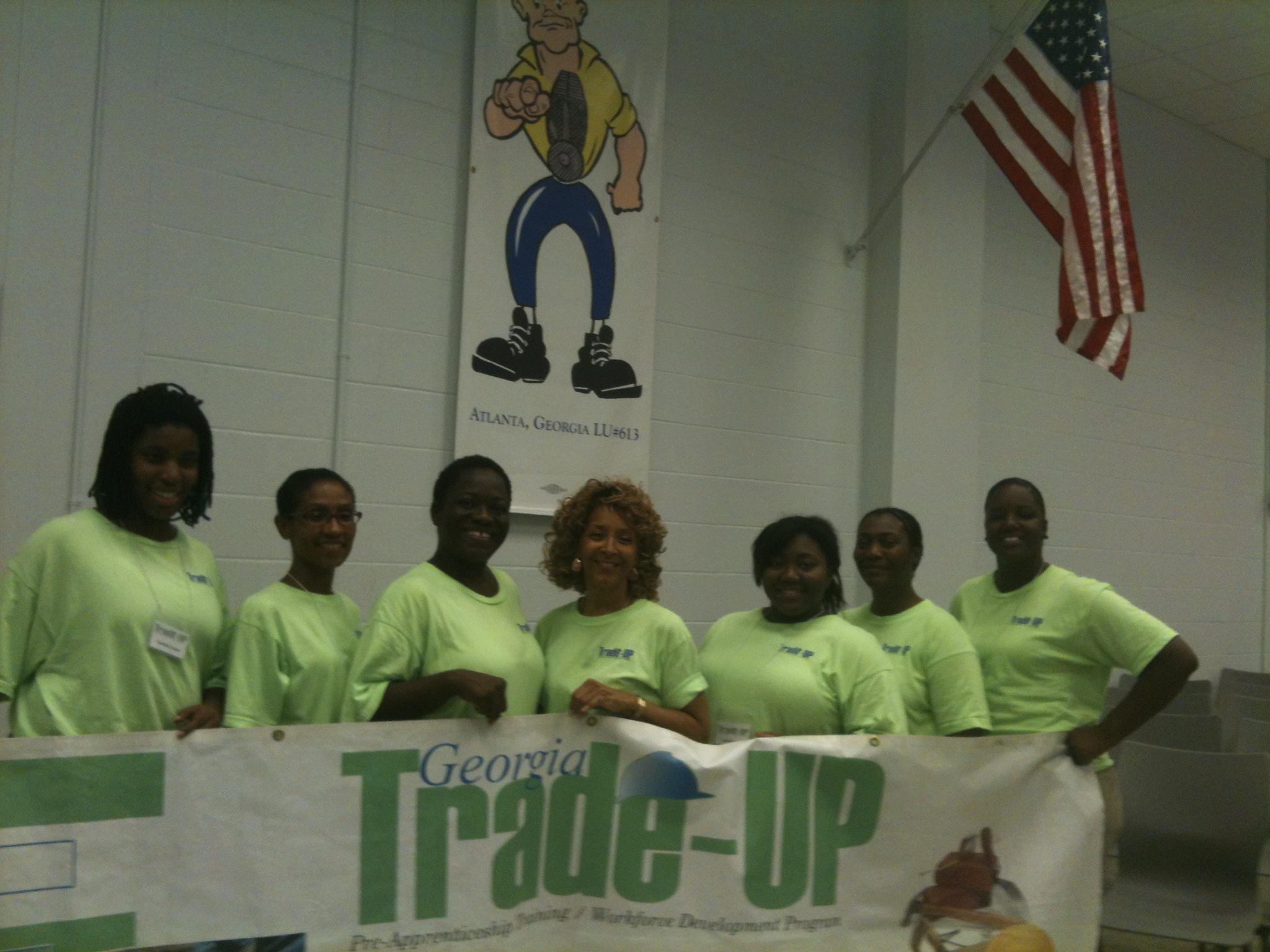
“This is a dream come true,” Treadville-Sanders said outside the auditorium where members of Georgia Stand-Up had just applauded the first all-female class of pre-apprentice trainees in its Trade-Up program. “I’ve prayed for something like this, but I never knew is would be like this.”
Students in the first all-female pre-apprenticeship program
offered by Georgia Trade-Up stand beneath a banner
of an iconic tradesman: Tyeshia Foster (left to right);
Lisa Brooks; Jacquelyn Treadville-Sanders (president);
Leslee Shepherd (coordinator); Janell Carter; Joanne Barker;
Chamena Johnson (secretary). Photo credits: David Pendered
Treadville-Samuels took a few moments outside the I.B.E.W. auditorium in downtown Atlanta to count her blessings. Even as she looks ahead to a good job that will enable her to provide for herself and her 8-year-old son, she’s contemplating how to give back to the community.
“I want to offer low-income housing for single parents because, if you’re not a husband and wife, you just can’t afford to buy a house,” Treadville-Samuels said.
“I want to go on and open my own business, and the only thing I ask is that I am able to take another woman under my wing and pay it forward,” she said.
“I want to teach our community that you can be better and do better, and there are people in our community who can help you do that,” she said. “There are so many people in our community who need an opportunity, or want an opportunity.”
Treadville-Sanders is enrolled in Georgia Trade-Up. It’s a pre-apprenticeship and workforce development program that teaches job-readiness skills to men and women who plan to enter construction trades apprenticeship programs or the construction industry. The program lasts eight weeks.
The all-female class in which she’s enrolled is funded by Goodwill Industries International. Goodwill, in turn, received the funding through the Department of Labor’s Women in Apprenticeship and Nontraditional Occupations program, according to Deborah Scott, executive director of Georgia Stand-Up and founder of Trade-Up.
Georgia was the only southern state to receive any of the $1.8 million the Labor Department announced in 2012. Goodwill received $300,000, the amount awarded each of the six programs nationwide, and promised to place at least 100 participants over the life of the two-year program into a registered apprenticeship program, according to a DOL statement.
These are good jobs in a field that’s anticipated to have labor shortages, Scott said. According to Scott, the Governor’s Office of Workforce Development has predicted openings for 82,000 skilled tradespersons by 2016. Some of those openings are due to workers who retired during the recession and aren’t expected to return to the field, Scott said.
To read the remainder of this article, visit http://saportareport.com/.

Wednesday, July 3, 2013

Repost: NH gender wage gap higher than national average

PGTI's own Elizabeth Skidmore recently served on a panel discussion about the wide wage gap between men and women in New Hampshire. Check out the article below to learn about the wage equality that's happening in the construction trades and how we can narrow the wage gap for all women.

---------------------------------------------------------------------------

Friday, June 28, 2013

By JENNIFER JANIAK

The wage gap between men and women has remained an unresolved social issue for decades, but Granite State women face even greater inequality in the workforce than others across the country.

New Hampshire women earn 77 cents for every dollar New Hampshire men earn, a 5 cent larger gap than the national average, according to the New Hampshire Women’s Initiative.

“It’s clear that there is a growing gap between men and women in the workforce today,” Mark MacKenzie, president of NH AFL-CIO, said Wednesday night at a forum titled “Women, Work, and Wages,” held at Saint Anselm College’s Institute for Politics to commemorate the 50th anniversary of the Equal Pay Act. “As of the last few years, it’s not had the kind of profile I think it should have. When you talk to the general public about this, it touches everyone.”

Four speakers addressed the wage gap with a variety of statistical findings, mostly focusing on the reason for women’s 23 percent wage loss.

About 14 cents of the loss-per-hour can be attributed to reasons like workforce participation, education attainment, industry and occupation, type of employer, and the preference for flexible work, according to Judy Stadtman of New Hampshire AFL-CIO. For example, Stadtman said that women tend to make up the majority of employees in lower paying sectors, such as elementary and secondary education and certain health care sectors.

“Even the 14 cents that is attributable … to career paths and lifestyle choices, we also need to understand that some of those career paths and lifestyle choices are because of sexism,” Liz Skidmore, one of the speakers, said. “Women grow up and think the only thing they can be is XYZ and … don’t do all the other things.”

However, the remainder of the gap, the other 9 cents, remains unexplained.

Skidmore is a business manager in the Carpenters Local 118 and has worked in carpentry for about 25 years.

Carpentry and construction are among the few job sectors in which women are paid equal to their male peers, she said.

“In union construction, women make exactly the same as men,” Skidmore said. “Starting 35 years ago, when women started getting into construction. Every hour we work, every dollar we get paid, we get paid exactly the same.”

The type of employer chosen by women, another factor Stadtman attributed to the wage gap, also differs from men. More women tend to work for nonprofit organizations and local and state government, while men dominate federal government jobs and the self-employment sector.

In attendance was newly appointed Labor Commissioner James Craig, who asked what can be done to solve the wage gap. While the four speakers offered different solutions, they all agreed that no single, or immediate, solution exists.

“There is no silver bullet to any of this stuff,” Skidmore said. “If there were, we would have solved it already. So what we’ve found is that if you can pull together a group of stake holders from long-term engagement on this … it’s not something that we can solve in one evening, but there absolutely are solutions and when we can bring people together, break down those aisles of expertise, and work toward it, that’s when I think exciting things happen.”

Read the remainder of this article at http://www.nashuatelegraph.com.


Wednesday, April 10, 2013

Repost: Wage Gap Persists in Most Occupations, Sales Jobs Worst Paying for Women

FOR IMMEDIATE RELEASE
Apr 09, 2013

Washington, DC–According to new analysis by the Institute for Women’s Policy Research (IWPR), women earn less than men in nearly all of the 114 most common occupations. Women’s wages are lower than men’s even in occupations dominated by men and women have the worst earnings compared to men in sales occupations, such as insurance and retail sales.

Occupations dominated by women provide lower earnings: Four of the ten most common occupations for women, ‘maids and housekeeping cleaners, ‘waitresses,’ ‘cashiers and ‘nursing, psychiatric and home health aides,’ have median earnings for a full-time week of work that are insufficient to lift a family of four out of poverty. Women are more than twice as likely as men to work in occupations with poverty wages

“The most common occupations for women show how far women have come, with good earnings in many occupations,” said Dr. Heidi Hartmann, President of IWPR. “But they also show the desperate, and all too common, problem of low pay for many women.”

Women ‘insurance sales agents’ face the largest gender wage gap; women’s median weekly earnings of $641 are only 64.3 percent of men’s median weekly earnings of $1026. ‘Retails sales persons,’ among the twenty largest occupations for both women and men, have an earnings ratio for women of 64.3 percent. Latina women’s median earnings in sales occupations are only 45.5 percent of white men’s earnings, the group with the highest median earnings in all sales occupations.

“Year after year, it is occupations with high commission payments that do worst for women,” said Ariane Hegewisch, IWPR Study Director. “Given lack of pay transparency, we have to rely on lawsuit evidence showing that women are not less likely to work hard in these jobs, but are less likely to be given the higher earning accounts or work in the big buck sales departments.”

The fact sheet is updated annually by IWPR and provides median earnings for the twenty largest occupations for women and men and distributions across occupational groups by gender and race, based on weekly earnings data from the U.S. Department of Labor’s Current Population Survey.


The Institute for Women's Policy Research (IWPR) is a 501(c)(3) tax-exempt organization that conducts rigorous research and disseminates its findings to address the needs of women and their families, promote public dialogue, and strengthen communities and societies.

View the original press release and contact IWPR at http://www.iwpr.org/.

Sunday, April 7, 2013

Repost: At Old Colony, unions prove their worth

After 70 years, the Old Colony housing project in South Boston is getting a fresh start. The aging complex at the rotary where Columbia Road meets Old Colony Avenue has been transformed into 116 attractive new rental units made up of wood-framed townhouse-style homes, a six-story midrise, and a community center. The enhanced view from Dorchester Bay across Joe Moakley Park is only the most visible change in the neighborhood. The second phase of the Boston Housing Authority's master plan is now underway under an innovative project labor agreement that will produce 169 more rental units and, as importantly, offer some of the project's residents a pathway out of poverty.

The master plan is the result of a year-long community process that will ultimately create another 453 units along with the goals for job opportunities for public housing and local low-income residents. The PLA negotiated with Boston's building trades unions incorporates language that exceeds the city's standard hiring goals for residents, minorities, and women by establishing additional employment preferences for Section 3 residents from Old Colonyand the city's other public housing developments.

The project is making use of Building Pathways, a pre-apprenticeship program servicing Greater Boston, as well as other programs that prepare recruits with the soft and hard skills needed to thrive in the challenging world of construction. The PLA's commitment to diversity has already borne fruit. Forty participants have completed the Building Pathways program and are working in the trades. Ten more will be placed in upcoming months and an additional training cycle has been scheduled.

Almost half of the graduates are women; all are low-income Boston residents in search of a career, not just a one-time job. Tyiesha Thompson has lived at Old Colony for 10 years. A 38-year-old single mother of three, Thompson is now a union apprentice working on a high-rise in the Seaport District. As phase two of Old Colony unfolds, she hopes to be part of the renaissance of her home community.

Read the rest of this article at http://bostonglobe.com.

By Mark Erlich, executive secretary-treasurer of the New England Regional Council of Carpenters.
(c) The Boston Globe Mar 22, 2013