The 2016 WOMEN BUILD NATIONS
conference will mark a momentous occasion for tradeswomen worldwide when
the conference convenes outside of California for the first time in its
15-year history. The annual conference brings together hundreds of
tradeswomen from multiple construction crafts to build leadership
skills, learn strategies for overcoming challenges and unite around
common issues.
Chicago Women in Trades is serving as
the local host committee of the 2016 Women Build Nations Conference and
partnering with the North American Building Trades Unions, along with
other national, regional and local tradeswomen advocates and other
allies.
Additional information regarding registration for the 2016 Women Build Nations conference will be announced in December of 2015.
In the meantime:
Download a Save the Date flyer for 2016 and share it with your sisters
and
visit: http://www.sbctc.org/ for newsletters, pictures and videos of previous years conferences.
For other conference information, contact kkupcak@cwit2.org
Hope to see you in Chicago this spring!
Showing posts with label trades. Show all posts
Showing posts with label trades. Show all posts
Tuesday, September 22, 2015


Friday, March 28, 2014
Repost: Breaking the Stigma in the Skilled Trades
Women are a resource to help address the looming shortage of skilled workers
TORONTO — As Ontario struggles to find a solution to a labour shortage that will require an estimated 40,000 skilled workers over the next decade, stigma blocks a potential workforce that could play a large part in rectifying the problem.The historical and misguided public perception that the skilled trades are the domain of big, brawny, handy men has resulted in a dearth of women in the trades, but it is past time to break down those barriers, says Tammy Evans, President of the Canadian Association of Women in Construction.
“We have unemployed and underemployed women who are a natural resource for entering the skilled trades,” says Evans, who will be at Future Building 2014 in an effort to reach the next generation of potentialtradeswomen. “Events like Future Building are a great opportunity to educate the public and really push the discussion to ask why not? Why not open the door to a woman in the skilled trades? Why not consider investing in training, hiring and promoting women in trades as a viable, homegrown, economic advantage to address the current and future shortage of skilled trades?”
Future Building, partnership of the Ontario Construction Secretariat (OCS) and Employment Ontario, is a three-day interactive trade expo geared towards students in Grades 7-12, showcasing the various skilled trades in the industrial, commercial and institutional construction sector, including masons, plumbers, glaziers, carpenters, ironworkers, steamfitters and sheet metal workers.
This year’s show will take place April 8-10 at the Mainway Recreation Centre in Burlington.
“The unionized construction sector has been actively working to increase the number of women in the skilled trades, and we expect we will see a lot of young women touring the show floor at Future Building,” says Sean Strickland, Chief Executive Officer of the OCS. “Technology has changed the needs of the skilled workforce. The opportunities in the construction trades are open to everybody. We need to talk about that, recognize it and promote it.”
An event like Future Building is necessary because the past two generations of students have been drilled that university is the only path to a career, says Evans.
“We have this perception of trades as not being for smart people, but that in fact is not true,” she says. “Skilled tradespeople are intelligent, professionally-trained workers. We need to elevate that profile. In the current market, a university graduate with a general arts degree, if they can find a job in their chosen field, should realistically expect a starting salary in the $40,000 to $50,000 range at best. They are unlikely to be above $50,000 to start. A first-year journeyperson coming out of trade school (depending on the particular trade) will likely earn between $60,000 and $70,000, and has the potential to earn a six-figure income within five years.”
To view the original article, visit http://www.exchangemagazine.com.
Friday, January 10, 2014
Repost: Introducing women and girls to trades and technical professions
By Miranda Burski, L-P Specialty Products
December 28, 2013
Trade and technical professions have, traditionally, been male-dominated fields. But that tradition is changing, thanks in part to work done by the Saskatchewan Institute of Applied Science and Technology (SIAST).
For the past several years, SIAST has partnered with Saskatchewan Women in Trades and Technology (SaskWITT) to introduce women and girls to various careers in the trades and technology fields. "We see that there is not gender equality in some programs, so we consider them to be male-dominated," says Anna Kwasnica, the provincial facilitator for SIAST's WITT programs. "Women don't face the same types of barriers that they might have 10, 15, 20 years ago in some of those areas, so now we're just looking at trying to get those numbers to increase."
As part of their partnership with SaskWITT, SIAST offers two main programs: one for girls in Grades 6, 7 and 8, and one for women in high school and above.
Girls Exploring Trades and Technology (GETT) camps take place each July at every SIAST campus across the province. The week-long day camps bring girls in Grades 6, 7 and 8 into contact with women who work in a variety of trades or technology fields. The camps also give girls the opportunity to work in pairs or teams on a number of projects, ending the week with the construction of a go-cart. SIAST has committed to running two GETT camps in 2014, the second of which will focus more on technical subjects such as sustainable energy and civil engineering.
The Women in Trades Exploratory course, meanwhile, gives women in high school and above the opportunity to experience a day in each of SIAST's trade shops. The hands-on course gives participants a better understanding of what training options are available, as well as an understanding of what is physically, emotionally and academically required to take part in one of SIAST's full training programs. The course is offered twice a year at the Regina and Saskatoon campuses, and registration is currently open for the courses taking place in January and February.
While the GETT camps are designed to introduce young girls to trades and technology in general, the Women in Trades Exploratory course is aimed more at women looking to explore their career options. "They get to actually use the tools in those shops and see if it's something that might be of interest to them," says Kwasnica. "We see a lot of people coming in that have maybe been nurses for 15 years that want to get out of that and want to do something with their hands because they're maybe looking for a change in life. And we see a lot of people coming out of high school that ... [say] 'I tried some of this in high school, but I can't decide between welding and electrical.'"
Since the partnership between SIAST and SaskWITT was launched, SIAST has seen an increase of the number of women enrolling in its trades programs. While enrolment still isn't as high as SIAST wants it to be, the number of women in trades programs doubled between 2007 and 2012. The numbers for technical programs remained consistent at about 15 per cent female enrollment.
"We see women coming into those areas - obviously those barriers are not the same as they used to be, so it's just kind of steadily increasing," says Kwasnica. "We want to see that, where it's not a question of equity anymore, it's just tradespeople."
For more information or to register for the SIAST and SaskWITT programs, call Kwasnica at 306-691-8446, or visit gosiast.com and click on "Women in Trades and Technology" under the "Programs and Courses" tab.
© Copyright (c) The StarPhoenix. Visit http://www.thestarphoenix.com to view the original article.
December 28, 2013
Trade and technical professions have, traditionally, been male-dominated fields. But that tradition is changing, thanks in part to work done by the Saskatchewan Institute of Applied Science and Technology (SIAST).
For the past several years, SIAST has partnered with Saskatchewan Women in Trades and Technology (SaskWITT) to introduce women and girls to various careers in the trades and technology fields. "We see that there is not gender equality in some programs, so we consider them to be male-dominated," says Anna Kwasnica, the provincial facilitator for SIAST's WITT programs. "Women don't face the same types of barriers that they might have 10, 15, 20 years ago in some of those areas, so now we're just looking at trying to get those numbers to increase."
As part of their partnership with SaskWITT, SIAST offers two main programs: one for girls in Grades 6, 7 and 8, and one for women in high school and above.
Girls Exploring Trades and Technology (GETT) camps take place each July at every SIAST campus across the province. The week-long day camps bring girls in Grades 6, 7 and 8 into contact with women who work in a variety of trades or technology fields. The camps also give girls the opportunity to work in pairs or teams on a number of projects, ending the week with the construction of a go-cart. SIAST has committed to running two GETT camps in 2014, the second of which will focus more on technical subjects such as sustainable energy and civil engineering.
The Women in Trades Exploratory course, meanwhile, gives women in high school and above the opportunity to experience a day in each of SIAST's trade shops. The hands-on course gives participants a better understanding of what training options are available, as well as an understanding of what is physically, emotionally and academically required to take part in one of SIAST's full training programs. The course is offered twice a year at the Regina and Saskatoon campuses, and registration is currently open for the courses taking place in January and February.
While the GETT camps are designed to introduce young girls to trades and technology in general, the Women in Trades Exploratory course is aimed more at women looking to explore their career options. "They get to actually use the tools in those shops and see if it's something that might be of interest to them," says Kwasnica. "We see a lot of people coming in that have maybe been nurses for 15 years that want to get out of that and want to do something with their hands because they're maybe looking for a change in life. And we see a lot of people coming out of high school that ... [say] 'I tried some of this in high school, but I can't decide between welding and electrical.'"
Since the partnership between SIAST and SaskWITT was launched, SIAST has seen an increase of the number of women enrolling in its trades programs. While enrolment still isn't as high as SIAST wants it to be, the number of women in trades programs doubled between 2007 and 2012. The numbers for technical programs remained consistent at about 15 per cent female enrollment.
"We see women coming into those areas - obviously those barriers are not the same as they used to be, so it's just kind of steadily increasing," says Kwasnica. "We want to see that, where it's not a question of equity anymore, it's just tradespeople."
For more information or to register for the SIAST and SaskWITT programs, call Kwasnica at 306-691-8446, or visit gosiast.com and click on "Women in Trades and Technology" under the "Programs and Courses" tab.
© Copyright (c) The StarPhoenix. Visit http://www.thestarphoenix.com to view the original article.
Wednesday, October 30, 2013
Repost: Ontario premier Kathleen Wynne talks youth jobs with St. Mary Catholic Secondary School students
Ontario Premier shares her concerns about the lack of women in the trades.
---------------------------------------------
COBOURG -- Through the power of the Internet, some Cobourg high school students got the rare opportunity to speak with Ontario Premier Kathleen Wynne.
Speaking to Meaford, Brampton, Ottawa, Cobourg and Toronto students during her first Google Hangout, Ms. Wynne answered questions from students about the Province’s youth jobs strategy, during the online chat on Oct. 17.
The Ontario government’s youth jobs strategy was unveiled on Oct. 16.
“The youth jobs strategy really builds on what’s been done in the past,” the premier said. “We want to help create a seamless path for our young people to find jobs.”
Ms. Wynne said the government relies on Ontario residents providing feedback on how politicians can help.
“We can’t always have conversations face-to-face like we are now,” she said. “But talk to your teachers, your guidance counsellors so they can help get the message out.”
During her online chat, the premier fielded two questions from St. Mary high school--one regarding the low number of women employed in the trades and opportunities for First Nations youth.
“It actually concerns me when I visit shops or tour job sites,” Ms. Wynne said, regarding the women in trades question. “I see a real unequal balance between men and women there. The Ontario government has a women in trades website that is geared towards helping women explore and find work in the trades.”
The premier added she would like to see trades opportunities exposed to young grades in elementary school, “before they enter high school so they have a better understanding of what type of trade they may want to pursue.”
She said the youth jobs strategy is to encourage all young people.
“Ontario has a rich and diverse workforce. We want all young people, no matter their background, to have the same opportunities,” the premier said, citing three current programs the government currently has to help First Nations youth pursue certain careers, such as law and natural resources.
To view the original article, visit http://www.mississauga.com.
For more information on the youth strategy program, visit www.ontario.ca.
Wednesday, October 16, 2013
Career Opportunity: Apprentice as an Operating Engineer
HOISTING & PORTABLE ENGINEERS Local 4
Apprenticeship & Training Program
The Training Center will accept applications for entry into the apprenticeship program during the month of November.
Each year at this time, Local 4 notifies appropriate agencies and interested parties regarding their application period. November is the only month that interested parties must apply in person at the Canton Engineers Training Center, One Engineers Way, Canton, MA 02021-3708 (Telephone: 781-821-0306)
To be eligible as an applicant, these basic qualifications must be met at the time the application is assigned.
To join the Apprenticeship & Training Program's inquiry list, please register online.
Apprenticeship & Training Program
The Training Center will accept applications for entry into the apprenticeship program during the month of November.
Each year at this time, Local 4 notifies appropriate agencies and interested parties regarding their application period. November is the only month that interested parties must apply in person at the Canton Engineers Training Center, One Engineers Way, Canton, MA 02021-3708 (Telephone: 781-821-0306)
To be eligible as an applicant, these basic qualifications must be met at the time the application is assigned.
To join the Apprenticeship & Training Program's inquiry list, please register online.
Monday, September 16, 2013
Repost: Apprenticeships lead to higher pay, but only for men
Young Canadian women who apprenticed had lower incomes than high school and college grads
Canadian men who complete an apprenticeship can expect to earn more than men who have only a high school education, more than men with trade qualifications and even more than many college graduates, according to a working paper on apprenticeships based on the 2006 census.
But the story is much different for women, with females who complete apprenticeships earning less than women with high school or college degrees or women in trades, according to the report Returns to Apprenticeship.
The study by University of Toronto researchers Morley Gunderson and Harry Krashinsky found male apprentices, who tend to be in the construction and mechanical trades, earned 24 per cent more than men who had a high school degree.
They brought home 15 per cent more money than those in the trades who were not apprenticed and two per cent more than college graduates. University graduates continued to outstrip those with apprenticeships, with incomes 40 per cent higher than high school graduates, though that number may be changing as the opportunities for university graduates diminish.
The results emphasize the value of apprenticeships, which many provinces are promoting as an alternative to college or university. With construction booming, businesses are reporting skilled trades shortages.
Unemployment among young people in Canada is now above 14 per cent.
Still, only a small percentage of the Canadian workforce has completed an apprenticeship — about 7.7 per cent of men and 1.6 per cent of women. The system of fostering apprentices is more common in Europe, but the study questioned why so few young men take on apprenticeships when the benefit appears to be so clear.
Canadian women were better off just completing high school, the study found. For women taking "an apprenticeship yields lower returns than simply completing high school and substantially lower returns than completing community college, likely reflecting the fact that female apprenticeships tend to be in low-wage jobs in industries like food and service," the study found.
The areas where women apprenticed were professions such as hairdressing and chef’s assistant. Those who completed apprenticeships earned 25 per cent less than women who completed college and 6.6 per cent less than high school graduates, the study found.
To read the full article, visit http://www.cbc.ca.
Tuesday, September 10, 2013
Repost: Female pipefitter in training gives thanks for Trade-Up’s pre-apprenticeship program
By David Pendered
on September 1st, 2013, 11:38 pm
As the United States pauses to honor workers on Labor Day, one Atlanta mother is thankful and proud that she’s on her way to becoming a pipefitter.
Jacquelyn Treadville-Samuels is changing careers after working as a forensic science technician in Atlanta and Alabama. She lost her taste for that work after caring for her cancer-stricken mother in Alabama. She returned to Atlanta and became homeless while looking for a job.
“This is a dream come true,” Treadville-Sanders said outside the auditorium where members of Georgia Stand-Up had just applauded the first all-female class of pre-apprentice trainees in its Trade-Up program. “I’ve prayed for something like this, but I never knew is would be like this.”
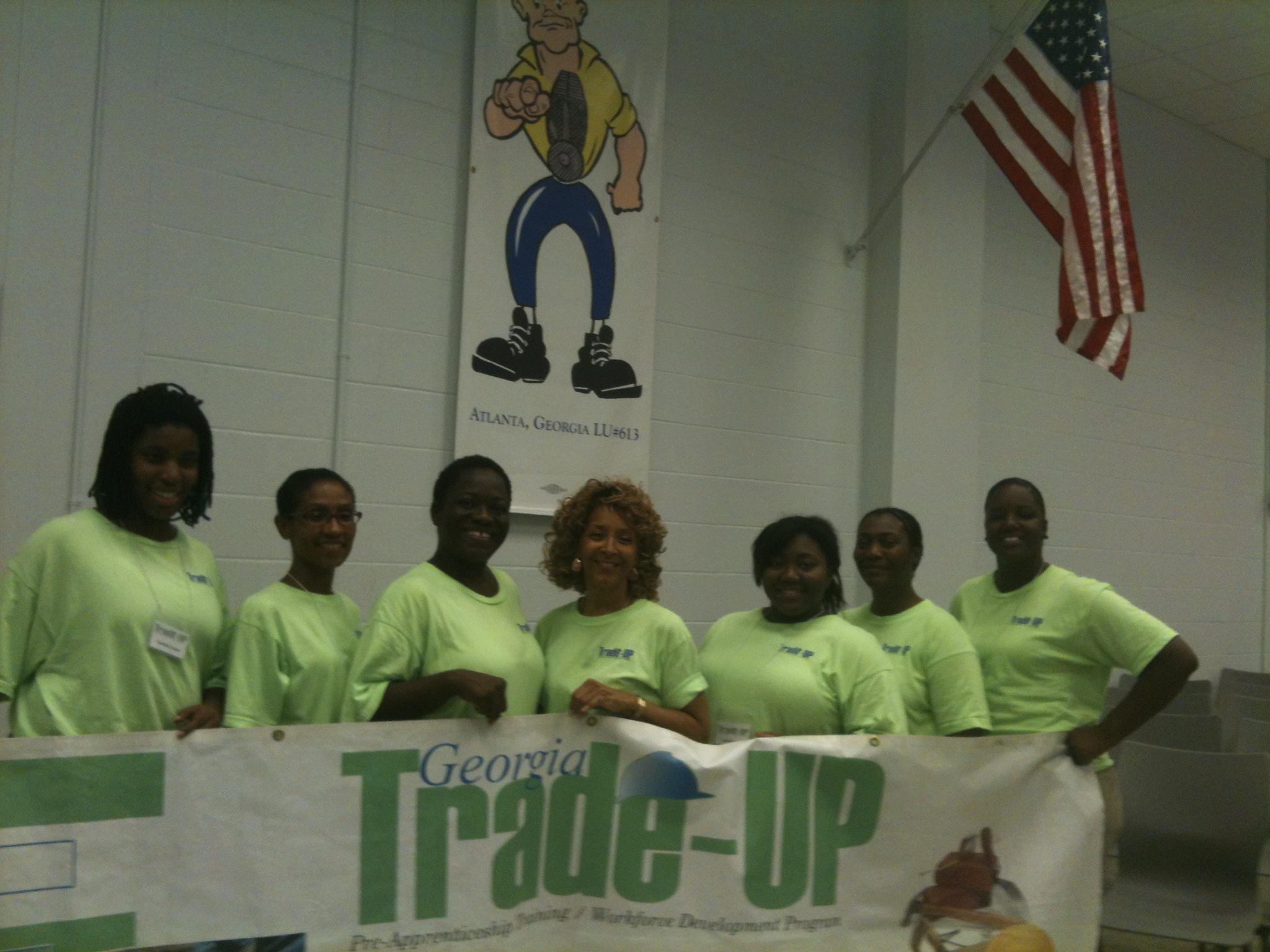 |
| Students in the first all-female pre-apprenticeship program offered by Georgia Trade-Up stand beneath a banner of an iconic tradesman: Tyeshia Foster (left to right); Lisa Brooks; Jacquelyn Treadville-Sanders (president); Leslee Shepherd (coordinator); Janell Carter; Joanne Barker; Chamena Johnson (secretary). Photo credits: David Pendered |
Treadville-Samuels took a few moments outside the I.B.E.W. auditorium in downtown Atlanta to count her blessings. Even as she looks ahead to a good job that will enable her to provide for herself and her 8-year-old son, she’s contemplating how to give back to the community.
“I want to offer low-income housing for single parents because, if you’re not a husband and wife, you just can’t afford to buy a house,” Treadville-Samuels said.
“I want to go on and open my own business, and the only thing I ask is that I am able to take another woman under my wing and pay it forward,” she said.
“I want to teach our community that you can be better and do better, and there are people in our community who can help you do that,” she said. “There are so many people in our community who need an opportunity, or want an opportunity.”
Treadville-Sanders is enrolled in Georgia Trade-Up. It’s a pre-apprenticeship and workforce development program that teaches job-readiness skills to men and women who plan to enter construction trades apprenticeship programs or the construction industry. The program lasts eight weeks.
The all-female class in which she’s enrolled is funded by Goodwill Industries International. Goodwill, in turn, received the funding through the Department of Labor’s Women in Apprenticeship and Nontraditional Occupations program, according to Deborah Scott, executive director of Georgia Stand-Up and founder of Trade-Up.
Georgia was the only southern state to receive any of the $1.8 million the Labor Department announced in 2012. Goodwill received $300,000, the amount awarded each of the six programs nationwide, and promised to place at least 100 participants over the life of the two-year program into a registered apprenticeship program, according to a DOL statement.
These are good jobs in a field that’s anticipated to have labor shortages, Scott said. According to Scott, the Governor’s Office of Workforce Development has predicted openings for 82,000 skilled tradespersons by 2016. Some of those openings are due to workers who retired during the recession and aren’t expected to return to the field, Scott said.
To read the remainder of this article, visit http://saportareport.com/.
Tuesday, February 26, 2013
Repost: A Day in the Life of a Woman in Construction
20 Questions for Women in Construction
Posted: 02/15/2013 1:07 pm
By Amy A. Peterson
Hard Hats. Strong Women. Building the Future.
Nontraditional Employment for Women (NEW) prepares, trains and places women in careers in the skilled construction, utility and maintenance trades, helping women achieve economic independence and a secure future. NEW graduates are working as carpenters, electricians, ironworkers, laborers, plumbers and operating engineers.
NEW was founded in 1978, when less than 3 percent of engineers were women and less than 6 percent of architects were women. Today, those percentages are above 13 percent and 25 percent, respectively. The number of tradeswomen hasn't grown as fast. Nationwide less than one percent of carpenters were women in 1978 and by 2009 the percentage nationwide was still less than 2 percent. According to the New York Building Congress analysis, "Construction remains a male-dominated industry, with men accounting for 93 percent of all workers." However, in New York City, the number of women in construction is growing. Today, thanks to a unique partnership between NEW, labor unions, contractors, and government, 10 percent of the apprentices in the building and construction trades in New York City are women.
Follow our blog to hear the stories of women working in construction in New York City at every level as we ask 20 questions to women working in construction.
Denise Doyle, D.C. 9 Painter, Recruitment Manager of Nontraditional Employment for Women (NEW), Recording Sec of Local 20 D.C. 9, Executive Board Council Delegate, Trustee - D.C. 9- Council Delegate
What was your first job in construction? Sanding walls
What is your current job? Recruitment Manager and Painting Instructor at Nontraditional Employment for Women
What job do you want in the future? I have honestly never thought about it, I love what I do now!
Are you in a union? What is the best part of being in a union? Yes, D.C. 9 Painters and Allied Trades Local 20. The best part of being in a union is being part of an organization that helps build New York.
Why did you choose construction? What led you to construction? I believe that construction chose me.
When did you realize you wanted to work in construction? When I was a first year apprentice I realized that I truly enjoyed my job.
Is there someone in particular in your life that led you to this career? My parents always told me that I can do whatever I wanted to do. And my husband is a Union carpenter.
Who inspires you? All the women in construction that paved the way before me.
What has been the most surprising part of being a woman working in construction? After earning respect, how great the guys were in teaching me their trade.
What is your favorite part of your career? Turning journey level.
What is your most memorable moment working in construction? 9/11/2001
What is your favorite project you have worked on? I have worked at the United Nations on two different occasions.
What is the biggest challenge of being a woman working in construction? Fitting in sometimes as the only woman on the crew.
What is the biggest change you have seen in the field since you started? There are more women now than when I started.
What advice would you give someone starting out? I would advise them that they need to earn respect and work hard every day.
What is your favorite tool? My 5-in-1
What is your favorite hard hat sticker? My D.C. 9 Local 20 Queens sticker.
What is your most valuable certification? What was the most challenging? My Labor Studies Degree from Empire State College that the union paid for. It was challenging to work and keep up with studies.
See the original interview at www.huffingtonpost.com.
Subscribe to:
Posts (Atom)