

Showing posts with label protest. Show all posts

Tuesday, March 13, 2012

Dueling forums address minority hiring in construction

Retrieved from: Dueling forums address minority hiring in construction

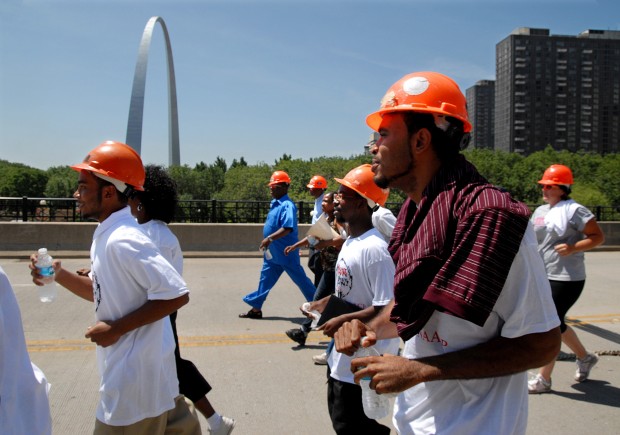
Jobs rally on Eads Bridge

    The discussion about minority hiring in the construction trade - a hot button topic that has vexed St. Louis for well over a half century – rose to the surface again Thursday in a pair of dueling forums that showed the issue is far from resolution.

    Yet the day's events also offered some hope that minority employment will improve after Metropolitan St. Louis Sewer District decided Thursday evening to set its minority hiring goal of 25 percent.
    Early Thursday afternoon, a consortium of leaders from major regional trade organizations led off with an announcement of what they envision as a “productive move forward” to remedy decades of the underrepresentation of minorities and women on local construction projects.

    Sunday, February 26, 2012

    Women in the trades demand fair hiring at Temple University


    Published Feb 24, 2012 9:09 PM
    Chanting “Temple University! Unions for All!” to the beat of Puerto Rican planera drums, construction workers and their supporters picketed a worksite at Temple University on Feb. 13 to demand fair hiring practices.
    The protest was organized by Margarita Padín, who has worked as a carpenter for 23 years and is a member of Carpenters Local 8; Joanna Harris, a member of Operating Engineers Local 542; Dianna Montague, a member of Ironworkers Local 405; and other women and men in the construction trades.
    Harris told Workers World: ” We are out here today because Temple University and L. F. Driscoll have had a lack of fair hiring practices for minorities and women at this particular location. It has been a history of Temple University and the other general contractors — the major contractors in the Philadelphia area — to not properly monitor, and hire with fairness, skilled trade laborers. Ironworkers, operating engineers, electricians — the women are not represented. The minorities are not represented.”

    Margarita Padín, right,
    at Feb. 13 protest.
    WW photos: Joseph Piette
    The Coalition of Labor Union Women, Temple students and Occupy Philly activists joined the protest, which received supportive comments from passersby and honks from passing cars.
    Padín said: “Temple University has $400 million in current construction projects in one of the poorest districts in the country, but the demographics of this district are not represented on these construction projects. These are the kinds of jobs that lift people out of poverty.”
    “The mandate for the make­up of the workforce should be the state of Pennsylvania as well as Temple University — they are in the middle of a minority-populated area. They should be monitoring fairly. … We’re going to be here until we see a change,” said Harris.
    The protest spurred Temple University officials and construction contractors to meet with organizers. But since no progress was made, the labor activists have announced another protest on Feb 20.

    Wednesday, November 23, 2011

    Korean Sit-In atop Crane Defeats Job Cuts

    Korean Sit-In atop Crane Defeats Job Cuts

    After 309 days sitting in on top of a 115-foot shipyard crane, a South Korean welder has won an agreement that her multinational employer will rehire 94 laid-off workers.
    Each will get $20,000 in back pay.
    Ending her sit-in in triumph over Hanjin Heavy Industries and Construction Company, Kim Jin-suk called the action “one last fight to win.”
    South Korean unions have not defeated corporations’ job cuts since 1997, when layoff rules were eased during the Asian financial crisis. That move was intended to break the region’s long-held tradition of lifetime employment.
    Kim rallied support to her cause via Twitter. Her supporters, calling themselves the Hope Riders, first gathered and discussed online and then occupied the streets of Busan and Seoul, the country’s capital.
    Kim survived Hanjin’s attempts to cut off her food, water, and electricity, and also her union leadership’s attempts to isolate her and her co-workers by clandestinely agreeing to a new contract.
    Each time she was threatened, the Hope Riders mounted larger and larger street protests, defying the riot police and right-wing thugs who confronted them.
    The Hope Riders grew strong enough to push the National Assembly to mediate a deal between Hanjin and the union.
    On October 9 at the legislature, Hanjin’s chairman tearfully agreed to pay laid-off workers and reinstate them within a year—if the sit-in ended. Most of the 400 originally laid off had already taken buyouts. Kim and the Hope Riders helped bring back the jobs of 94 of the remaining 98.
    On November 9, in one last move to avert the union’s victory, 500 riot police surrounded Crane 85 to arrest Kim and effectively aborted a union vote to approve the deal. After fierce protests, police finally withdrew. A day later, union members unanimously approved the agreement.
    When the 52-year-old Kim occupied the control room of Crane 85 nearly a year ago, her co-workers feared the action would end the same way as another crane sit-in, conducted by Kim Ju-ik, who hanged himself after 129 days protesting job cuts in 2002.
    Touching the ground for the first time, Kim Jin-suk said, “I wanted to prove that the cause for which I have been fighting half of my life and for which many comrades have died is right.”
    She was escorted by supporters to a hospital for medical checks. Plainclothes police officers are now surrounding the hospital, waiting for a chance to arrest her for illegal occupation and trespassing.
    Using the same cell phone she employed to motivate tens of thousands of new activists into action in South Korea, Kim addressed the general assembly of Occupy Wall Street in New York on October 8 through an interpreter.
    She declared her sit-in part of “a global fight against corporate nastiness.” Kim’s triumph adds to the momentum of the rising global protest against the 1 percent.
    Kap Su Seol is a research analyst by day and a freelance writer at night. He is currently at work writing a corporate history of Samsung, South Korea’s multinational conglomerate.